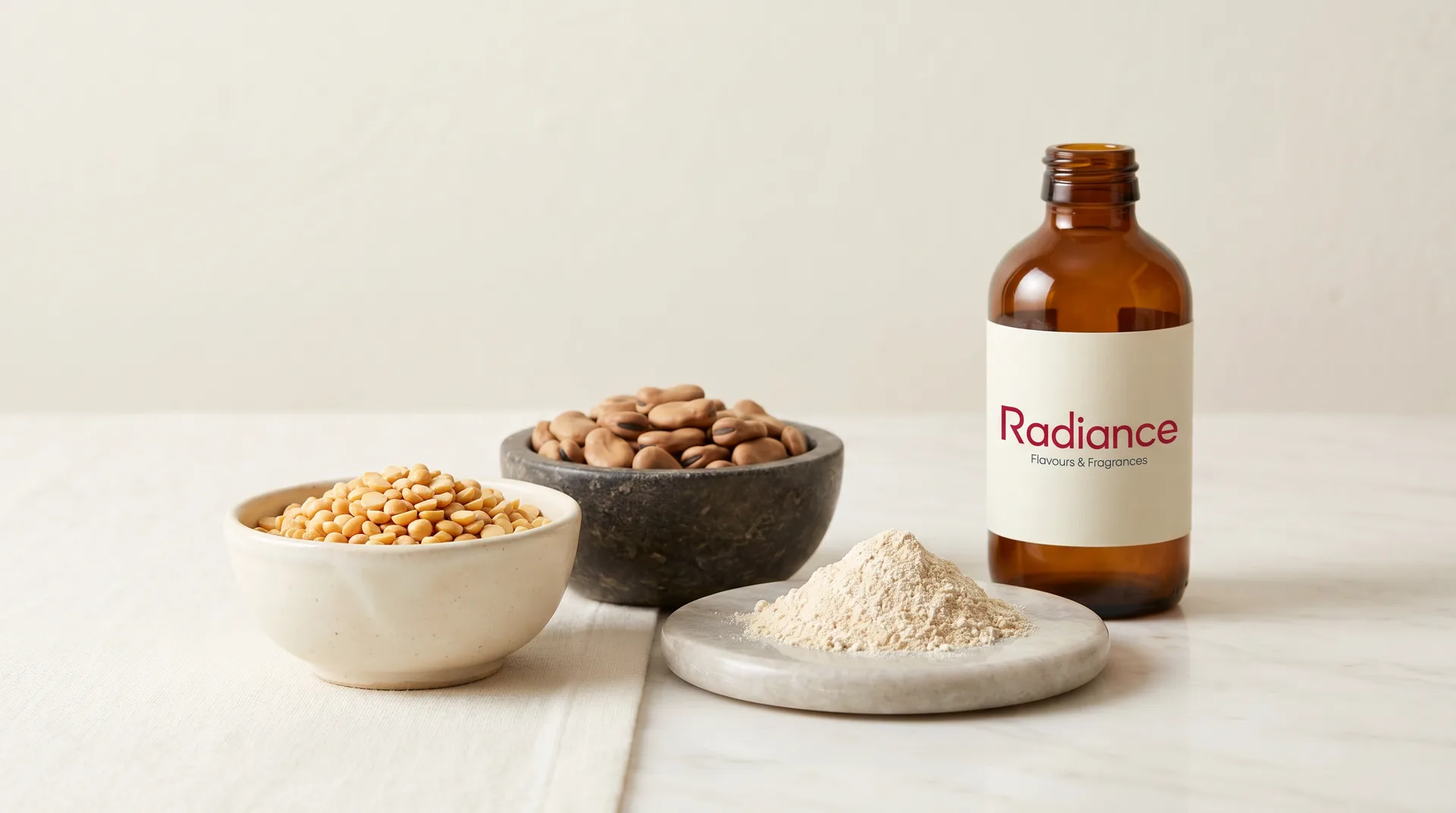
In a plant protein-based product, the flavour's job is not to give taste but first to clear the ground. Until the beany, earthy and bitter background brought by pea and faba isolates is resolved, no taste profile settles into place.
Almost every team developing plant-based products stumbles in the same place. The formula works on paper, the protein content is on target, the texture is acceptable; but when you taste the product there is something in the background. A beany, faintly earthy bitterness that does not go away after you swallow. This is not a formulation error; it is the raw material itself. And it does not disappear when you add vanilla on top.
This character in pea, faba and soy isolates comes not from the protein molecules but from the components that accompany them. You cannot solve the problem correctly without naming it correctly.
Where the off-note comes from
A legume seed remains a living chemical environment even after harvest. The lipoxygenase enzyme naturally present in the seed oxidises unsaturated fatty acids and produces a series of volatile compounds: hexanal, nonenal, various aldehydes and ketones. These are responsible for most of what we call "beany", "green", "grassy" and "cardboard" notes. As the cell structure breaks down during milling, soaking and heat treatment, the enzyme meets its substrate and the reaction accelerates. In other words, the off-note is most often produced not in the field but on the processing line.
Bitterness and astringency are another story. Saponins, phenolic compounds and certain peptides trigger the bitter receptors (the T2R family) directly. The perception arrives late and lasts a long time; that is why it leaves an impression that "stays after swallowing". These are not volatile — they are taste, not smell. Having both a volatile-derived odour problem and a non-volatile taste problem in the same product weakens any search for a single-flavour solution from the outset. Two different mechanisms require two different interventions.
There is one more distinction: isolate, concentrate or flour? As the degree of protein purification rises, some unwanted components are removed, but the processing conditions applied during purification can generate new oxidation products. A high protein content is no guarantee of a clean taste.
Masking, blocking, modulation: what each one does
These concepts are frequently used interchangeably in the industry, yet the job they do is different. Masking means covering an unwanted note with a more dominant odour; it is done with strong characters such as vanilla, cocoa, roasted hazelnut and spice, it acts quickly but it drags the profile with it — the product is no longer "pea-flavoured" but "vanilla-flavoured", and as the dose rises it turns artificial. Blocking suppresses the bitter receptor's signal at the level of perception: it does not cover the note, it weakens its perception, and used correctly it leaves the product's own taste profile untouched. Modulation reshapes perception by shifting the taste balance; adjustments of umami, saltiness, light sweetness and acid head off bitterness and the metallic note. And then there is intervention at source: reducing off-note formation at the outset through raw material selection, enzyme inactivation and oxidation control. The most durable solution lies here.
In practice none of them is enough on its own. In a well-built system the source is reduced first, the remaining bitterness is blocked, the taste balance is modulated, and the flavour that serves the character is left until last. When the order breaks down, the cost multiplies.
Approaches that work in the field
Roasted and fermented notes are among the families most compatible with plant protein. Roasted cereal, cocoa, malt and nut characters do not feel alien to the legume's natural "dry pulse" background, so laying them on top creates no contradiction. Clear fruit profiles, by contrast — citrus and red fruit in particular — collide with the earthy base of pea; technically possible, but far more laborious.
The salt and acid balance is underrated. Salt suppresses bitter perception directly; acid, depending on the matrix, sometimes cleans up the finish and sometimes hardens it. Both are levers that should be tried before touching the flavour dose, and they will often let you lower that dose.
The application matrix is decisive too. Because the fat phase holds volatiles, an isolate you found neutral in a fatty product can behave like a different raw material in a low-fat beverage. That is why an evaluation means nothing until it is carried into an application test in the final product.
This work does not run without a sensory panel
Off-note work does not run without a proper vocabulary. There is no such definition as "bad taste"; beany, green, earthy, cardboard-like, metallic, soapy, bitter, astringent — each points to a different mechanism and calls for a different solution. A panel trained on a shared vocabulary separating out these notes and placing them on an intensity scale directly determines how many trials the formulator will run. Seeing the volatile profile on the analytical side serves the same end: if you can see which compound rises at which processing step, you have a chance to fix the process before you start wrestling with the flavour.
Splitting the evaluation in two helps: taste the raw material on its own first, then in the final matrix. The difference between the two evaluations usually tells you where the project is going.
“Flavour used to rescue a bad raw material is the most expensive solution there is; you pay for it again in every batch.”
The most expensive route: rescuing a raw material with flavour
Starting with a cheap isolate and trying to close the gap with the flavour dose looks reasonable at first glance. The raw material cost per kilo is low, and flavour is used in small doses. But the arithmetic does not end there. A high flavour dose makes the product artificial and conflicts with label expectations. Worse, a low-quality isolate has high batch-to-batch variability; without the records kept at raw material intake and batch analysis, the dose that holds today does not hold in the batch three months from now. You end up constantly re-tuning.
A step taken on the raw material side — a better isolate, a supplier who performs enzyme inactivation properly, storage that protects better against oxidation — usually costs less than what you would spend on flavour, and it lasts. Flavour exists to build character on top of that cleaned-up ground. Not to plug holes.
In the plant protein category the consumer's acceptance threshold is rising fast; it is no longer enough for a product to be good within its own category, it competes with everything on the table. So start your next trial with the raw material rather than the flavour: taste the isolate you have, with nothing added, in the product's real matrix, and write down which note comes from where. That list will determine how many trials you run before the flavour ever enters the picture.