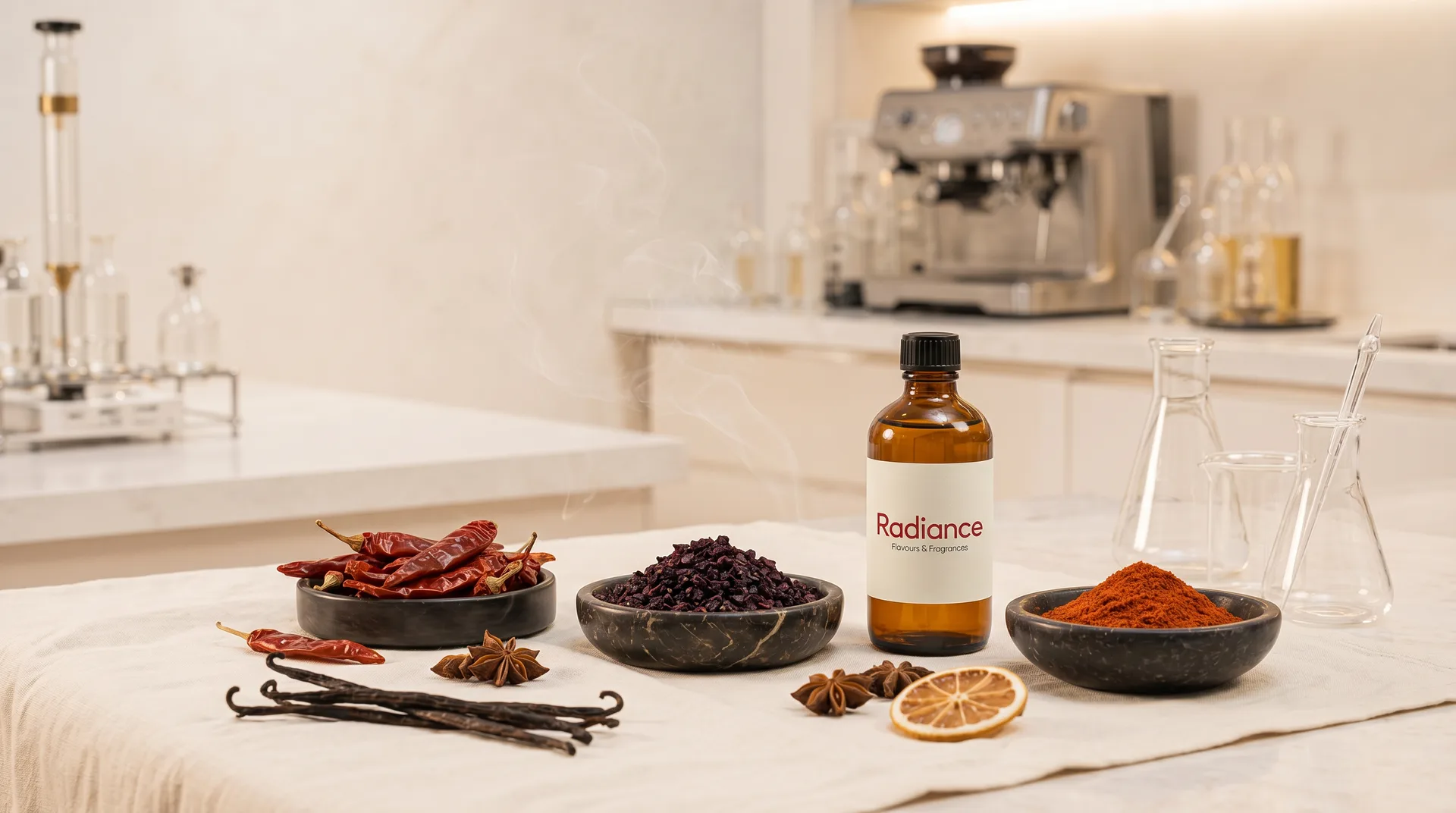
Hot and smoky are the two fastest-growing profiles on the snack shelf. Neither works on the sweet-salty axis; one speaks to nerve endings, the other to memory. And that is exactly why formulation errors are noticed late.
If a seasoning manufacturer had a single hot product in the portfolio last year, this year there are probably three. Crisps, extruded products, nut coatings, crackers — whichever category you look at, the share of hot and smoky profiles is growing. This is not the result of a single fashion; it is several trends coinciding.
Why hot is growing
Young consumers are not looking for taste, they are looking for an experience. Heat is the ingredient that can produce an experience most cheaply in the snack category: the person eating feels something, can share that feeling, can get a friend to try the same thing. Chilli challenges on social media are the extreme end of this, but the real volume is not at the extreme; it is in the "bearable but noticeable" band.
The second driver is the spread of world cuisines. The Korean hot-sweet axis, the Mexican lime-chilli pairing, Southeast Asia's hot-sour construction are no longer foreign to the consumer at the shelf. The third, and the most overlooked, is the local palate. In Turkey, heat is already at home. The smoky, late-arriving heat of isot, the sharper opening blow of pul biber, the red pepper culture of Gaziantep — these offer a foundation to build on rather than an imported trend to copy. When developing a seasoning, putting the isot character at the centre instead of imitating "Nashville hot" is a sounder route both for differentiation and for supply.
Heat accumulates over time
The most common mistake in formulation is treating heat as a scalable taste like salt or sweetness. Capsaicin works not through the taste buds but through heat and pain receptors. You see the consequence in two ways. First: the perception arrives with a delay, which makes the "let us add a bit more" reflex dangerous on a sensory panel; you notice what you added ten seconds later. Second, and more critically: heat accumulates. A product that looks balanced on the first bite pushes the consumer to close the pack on the tenth.
Because the entire snack business model depends on the pack being finished, this stops being a formulation matter and becomes a commercial one. The sensory evaluation of a hot product cannot be done with a single bite. Sequential consumption has to be added to the panel protocol: the same panellist scores the heat at set intervals while consuming a real portion at a real pace. What you are looking for is not the peak value but the shape of the curve.
“Judging a hot product on the first bite is like judging a climb on the first step.”
Smoke: the narrow band between depth and soot
A smoky note at the right dose adds age and weight to a product; the consumer reads this as "cooked over fire", "homemade", "real". At the wrong dose it says only one thing: ash. Its chemical equivalent is the balance formed by guaiacol and its derivatives together with the other phenolic components. At low concentration guaiacol gives a woody, rounded depth; once it passes the threshold, perception shifts quickly towards smoke and soot. Heavier phenolic fractions extend persistence on the palate — good if that is what you want, but if it is not, your product stays in the mouth longer than it should.
The practical consequence: smoke dosage does not behave linearly. A fifty per cent increase does not produce a fifty per cent increase in perception; most of the time it changes the character. That is why, in smoke work, building a narrow-interval series rather than wide-interval trials is the only reliable way to see where the threshold lies.
Layering: a base that can carry heat and smoke
Left on their own, heat and smoke come across as hard and one-dimensional. The base that can carry both is usually a fruity sweetness. The reason has less to do with pleasantness than with structure: a sweet top note softens the opening blow of the heat and shortens the heavy phenolic tail of the smoke. The consumer describes this as "balanced"; what they are actually feeling is the peak of the heat being delayed and the finish being cleaned up.
The headings to think through when layering:
- Top note: the character that will be read the moment it enters the mouth — citrus, tomato, vinegar or a light fruit acid.
- Mid-body: where the smoke lives. Woody depth belongs here; sharp soot does not.
- Heat curve: when the peak arrives and how far it climbs over how many bites.
- Finish: what stays on the palate? A long phenolic tail lowers the desire to eat more.
- Salt-sugar ratio: it affects heat perception directly and is usually a lever to be set before the flavour; in sugar-reduced formulations you have to account for how much narrower that lever becomes.
Distribution in the powder: the real difference on the shelf
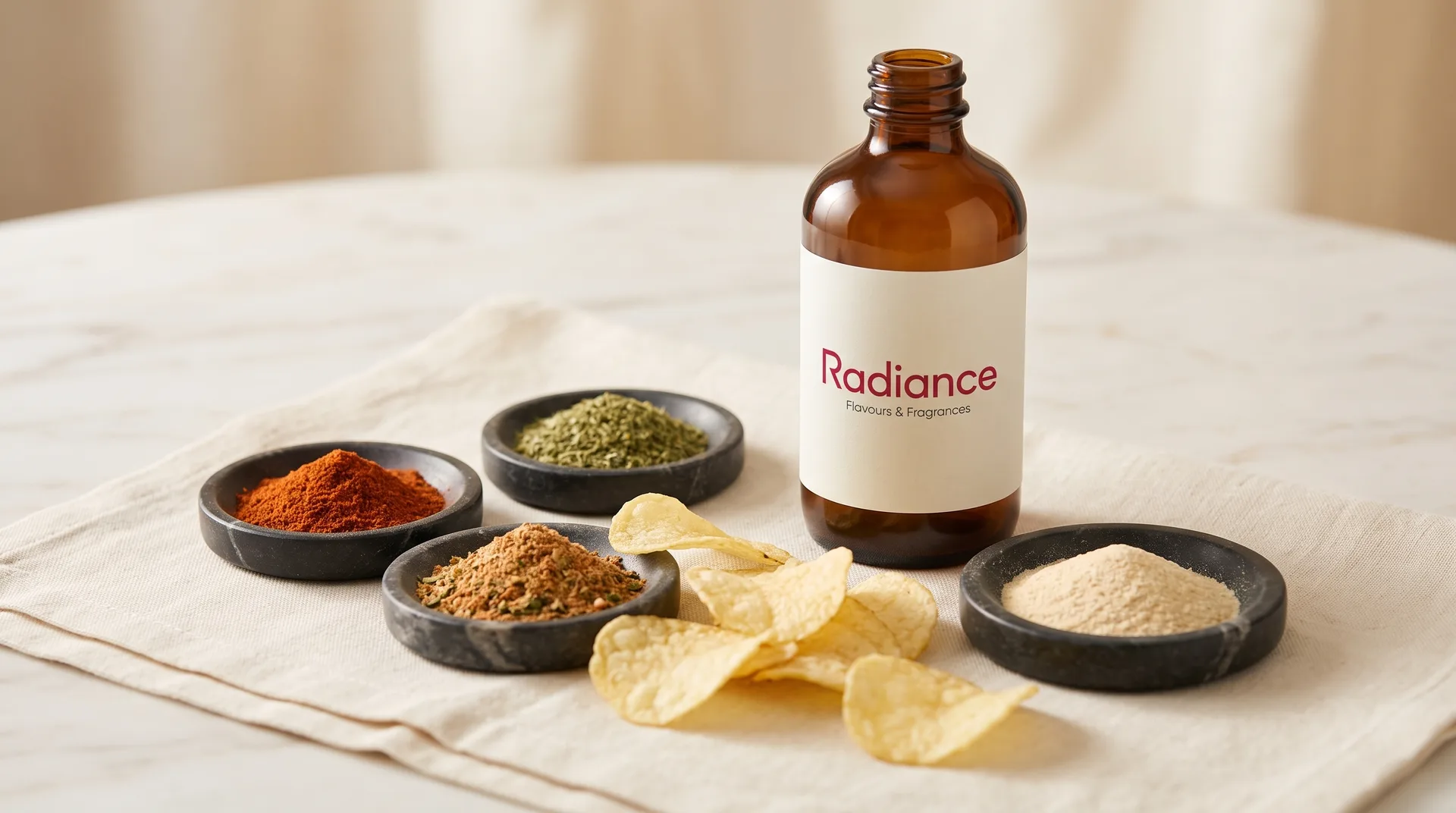
The difference between what a hot-smoky profile looks like in the laboratory and what it looks like in the pack is usually explained by distribution. This is also what makes the scale-up stage a separate topic on the way from sample to series production. In a powder seasoning, spice, salt, sugar, carrier and powder flavour exist at different densities and different particle sizes. The moment segregation begins in drum coating or during transport, the product at one end of the pack stops being the same product as the one at the other end. With heat, this error is unforgiving: when a consumer experiences three different levels of heat in three bites, they label the product "inconsistent" and cannot even explain why.
This is exactly where the role of powder flavour begins — but not where people think. A flavour embedded in a carrier matrix by spray-dry takes the volatiles inside a capsule, makes dosing into a dry system possible and slows the loss markedly compared with a free system. Slows it, does not eliminate it: as the matrix softens with moisture and temperature, the capsule wall becomes permeable. In smoke notes this is especially critical, because the light end of the phenolic profile is the first part to be lost — a few months later you may be left with a product whose depth has gone and only the heavy tail remains.
Assuming that powder flavour solves segregation by itself is a common fallacy. A powder flavour is a particle too; if its size and density are not matched to the carrier spice, it becomes part of the segregation rather than its solution. The solution lies not in a single ingredient but in the whole equation: matching particle size and density, the amount of coating oil, the residence time in the drum. These are things decided on the production line, not in the formulation notebook — and in a hot-smoky seasoning they determine the product's fate on the shelf more than the formulation does.
In the hot-smoky category, what separates the winning products is rarely a bold idea. The idea is already out there. What separates them is whether that idea is still standing on the tenth bite and in the third month.